I’ve not long returned from another trip to the Lake District; can you sense a trend, here? This was my third visit to the Lakes in eight months and needless to say it’s becoming a bit of an obsession; I’ve absolutely been bitten by the bug. I was staying in Keswick again this time, for a long weekend in another Airbnb, which has really become my go-to approach to finding accommodation lately. I booked the stay back in mid-January, for the first week in March, in the hope that there might still be a bit of snow on the mountains. My talents, such as they are, do not yet extend to controlling the weather, so until such time as the status of deity is conferred upon me, hope was all I had. It wasn’t a big deal though, a snow no-show wouldn’t matter. It’s the Lake District after all… a great weekend still lay ahead.
Climbing Skiddaw
The plan for this trip was to climb Skiddaw (pronounced Skidda apparently, which I always seem to forget), a significant step-up from my previous two climbs in the Lakes, of Catbells and Barrow. At a height of 3,054 ft (931 m) Skiddaw is the sixth highest mountain in England, and over twice the height of Barrow, and a much longer climb to boot.
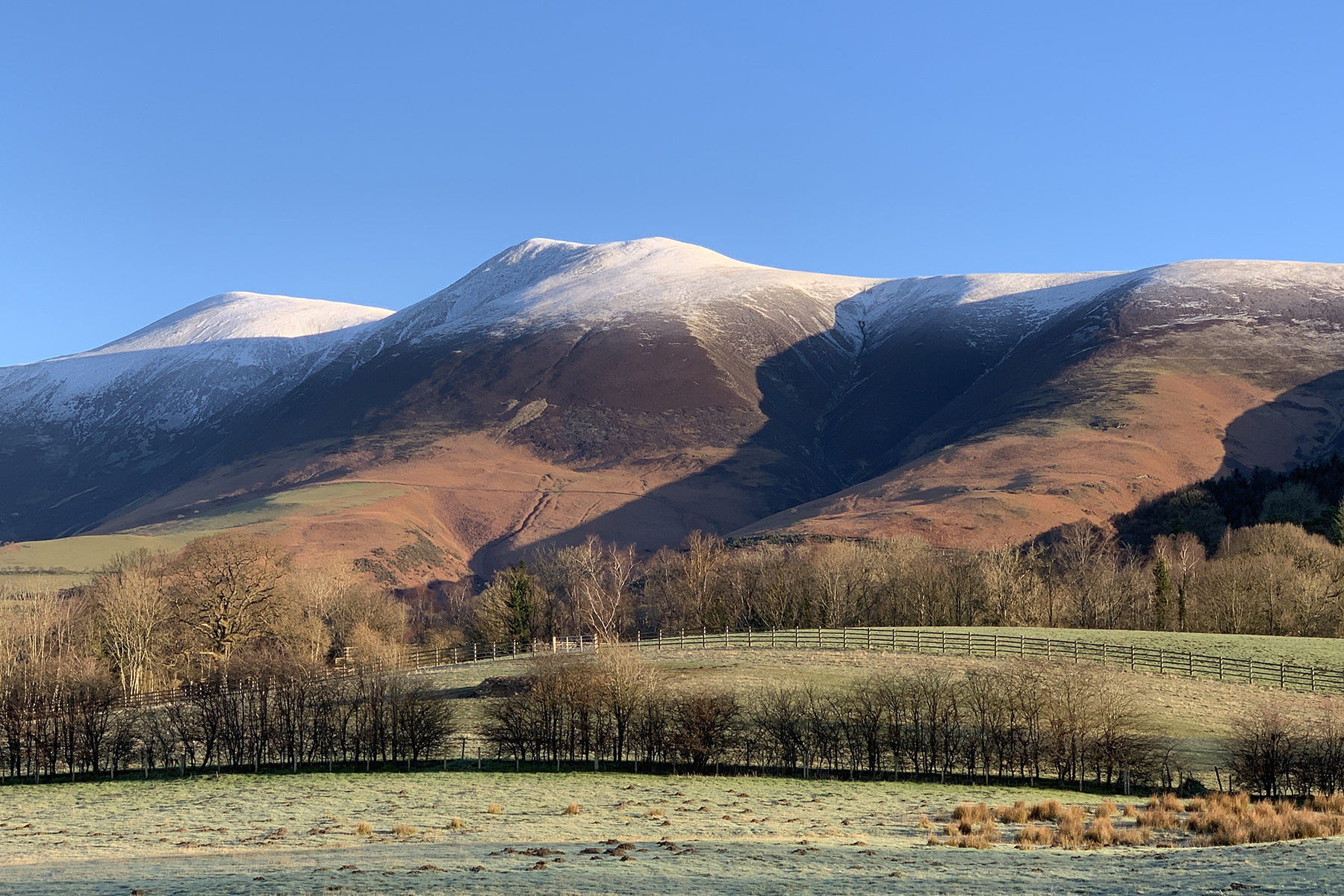
The Skiddaw Massif is arguably the most prominent feature of the Keswick skyline and when I arrived in the town on Friday afternoon, Skiddaw itself was topped with a very light peppering of snow, but there was a lot of bare earth peeping through. At that point though, I was happy enough. I’d been crossing my fingers for snow, and there was snow, albeit rather patchy. But that would do nicely. I stocked up on provisions for the following day’s adventure, and headed for my lodgings.
The next morning I was up with the larks, made myself a hearty, protein-rich breakfast, packed my backpack and stepped out into the cold, sunny morning. As soon as the great profile of Skiddaw came into view for the first time I became very excited. What had been a mere suspicion of snow the day before had been transformed overnight into a thick, continuous blanket of white. Woop! I couldn’t wait to get going and get up there! I’ll level with you though, reader, I was actually a little nervous. As it rose up into the blue ahead of me I was struck by how monumentally high it was. Of course it’s no Snowdon, or indeed Ben Nevis, but it’s pretty colossal nevertheless. Whereas Catbells and Barrow are much smaller, Skiddaw is a mountain in the true, technical definition of the word, and is the parent peak within a range of other huge summits. Seeing all these great mountaintops looming before me, each one connected to the next in one great mass, was an imposing sight. Still, this was why I was here; it was a challenge, and that was largely the point.
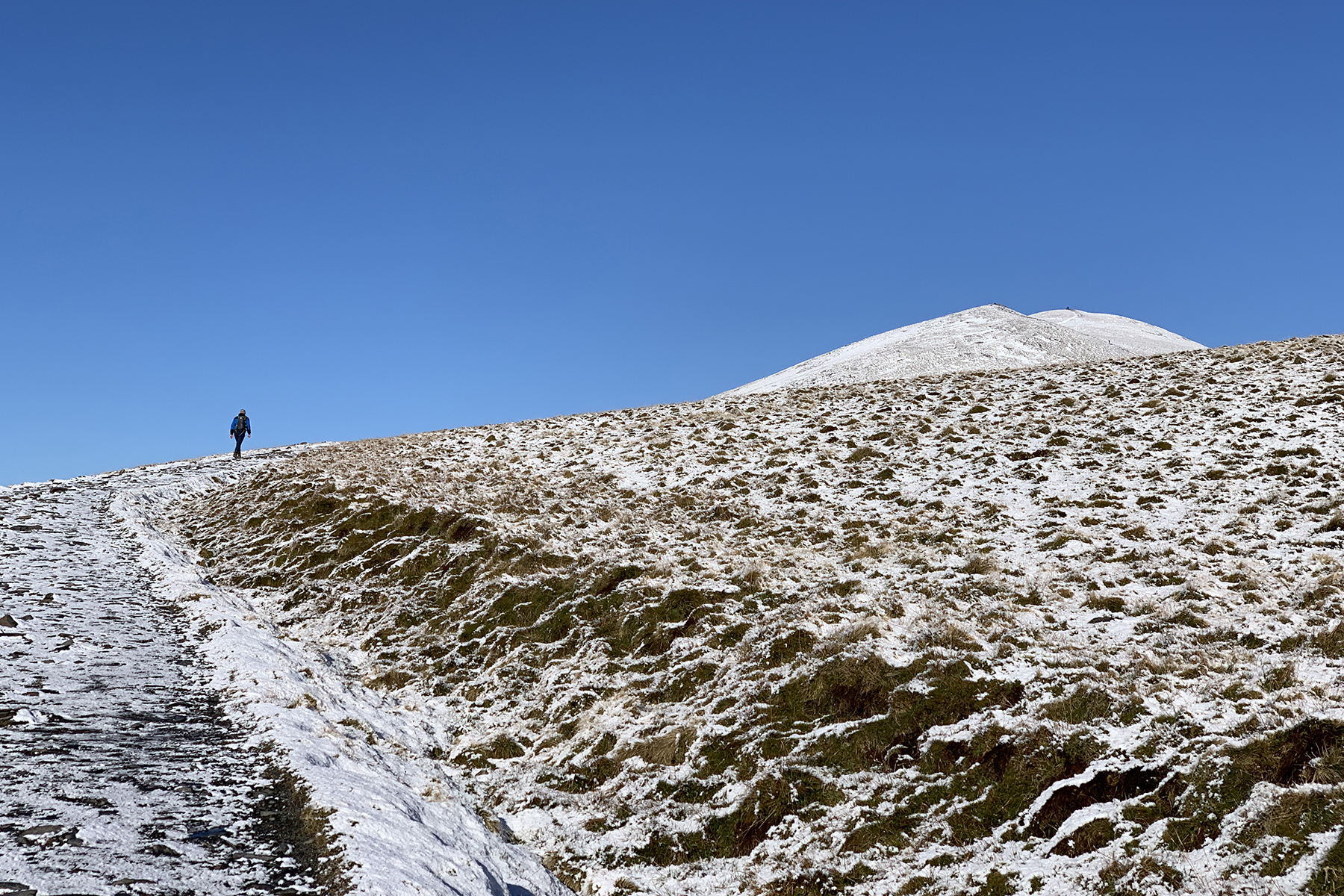
I’d decided to follow the Jenkin Hill path, deviating from it slightly to enable me to top Skiddaw Little Man as well, rather than skirt it. There are many other trails which take in different views and different fells (Wainwright lists about seven routes, I think), but from Keswick the Jenkin Hill path made the most sense. And I’d like to point out that I was starting from the town, not from the Gale Road car park which would have cut out about the first quarter of the walk, and about a third of the height. Yes, I am that hardcore.
In fact, that first section of the hike up to Gale Road was a rather gentle ramble, all told, passing through and edging patches of woodland before emerging into a more open hillside path. It was rather nice on reaching the Gale Road car park, to see a few other hikers and mountain bikers in the early morning sun, getting themselves ready for their adventures. There’s something very enjoyable about solo hiking, but I love the sense of camaraderie you get when meeting other people on the same expedition, even if you just wave and say “Hi”.
Beyond Gale Road the “official” Jenkin Hill path begins, and all roads are left behind. The air was now getting noticably colder, and the gradient steeper, as I followed Whit Beck for a while with Lonscale Fell off to the north and the first patches of white soon began to appear underfoot as I reached the snowline. Now we were getting into it! From here there’s no let-up, it’s one long, uphill climb until you reach the top of Lesser Man where the trail dips slightly before ascending again to the peak of Little Man. I have to say, the cairn at the top of Lesser Man is an ugly sight, amounting to nothing more than a tangle of rusted old fence posts jammed randomly into the more traditional pile of rocks.

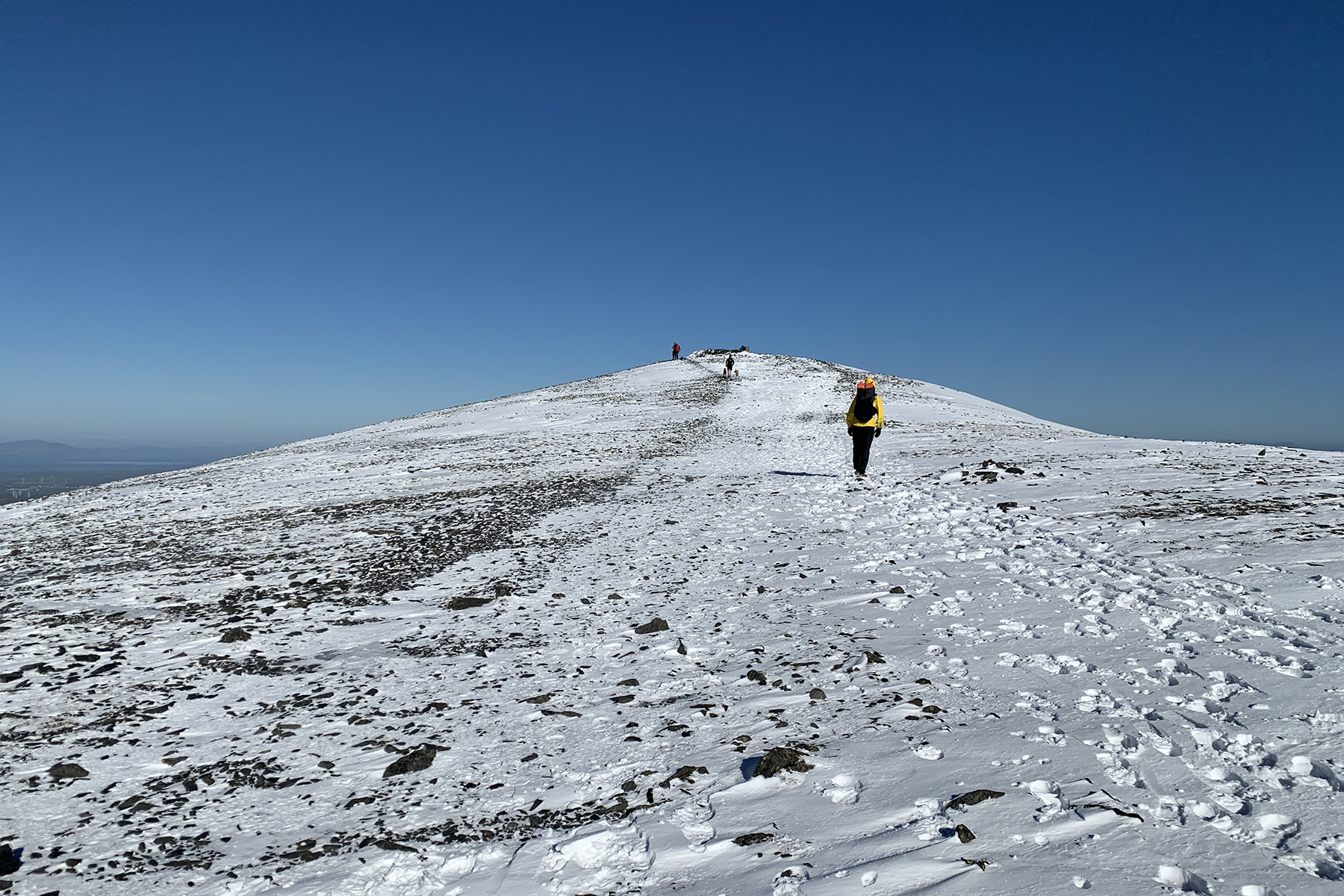
The last leg of the climb began with an initial descent into the col between Little Man and Skiddaw itself. The conditions were getting seriously turbulent by now, and in fact I’m not sure I’ve ever experienced anything like it. The snow underfoot was much deeper and up to my calf in places, but the real adversary was the wind – ice-cold and ripping across the trail from the east. It was easily powerful enough to throw you off your balance and with it came a continuous flurry of powdery snow that it had gathered up on its route across the fells. The noise was immense – a plaintive, howling cry accompanied by a high-pitched whistle, sounding for all the world like a movie sound effect. The final ascent to the summit of Skiddaw really wouldn’t have been too arduous had it not been for the battle with the elements. It was fierce, but completely exhilarating and exactly how I’d hoped it would be; it felt like a true adventure. Reaching the peak is always a buzz, but this time felt like a genuine achievement.
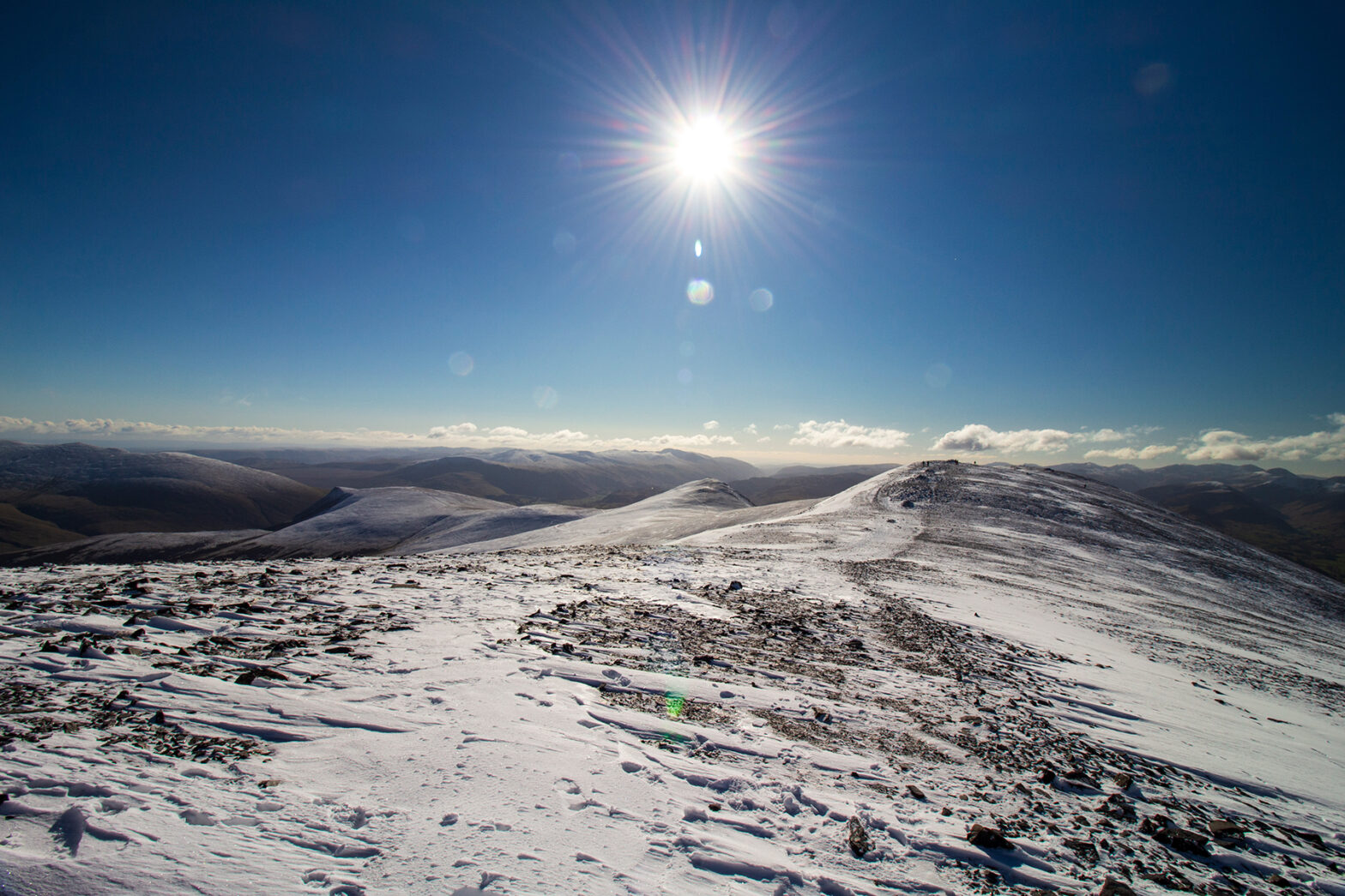
I’d got my snow and my view! And it was nothing short of incredible. Whichever way I turned I was met with an awe-inspiring sight. From the summit of Skiddaw back to the south-east and Little Man was a wide vista of blue-white slopes, smooth and undulating. To the south-west beyond Derwentwater, an alpine snow-scape where the serrated profile of every fell and mountain that marked the horizon was capped with white. And to the west lay the narrow cornflower blue ribbon of the Irish Sea. Of all my recent hikes and climbs in Lakeland, this was without doubt the most rewarding so far. By great good fortune I’d picked the perfect day.
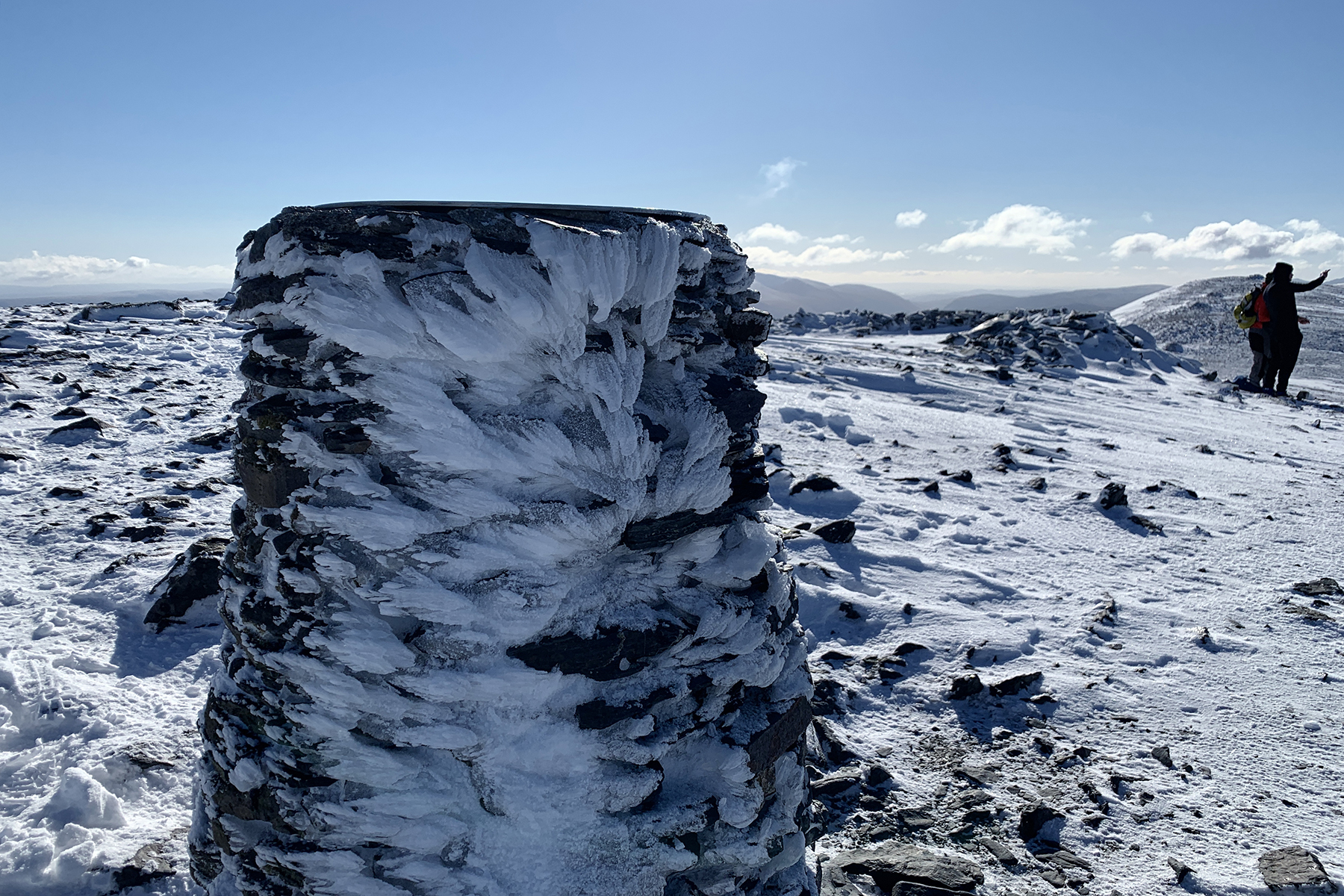
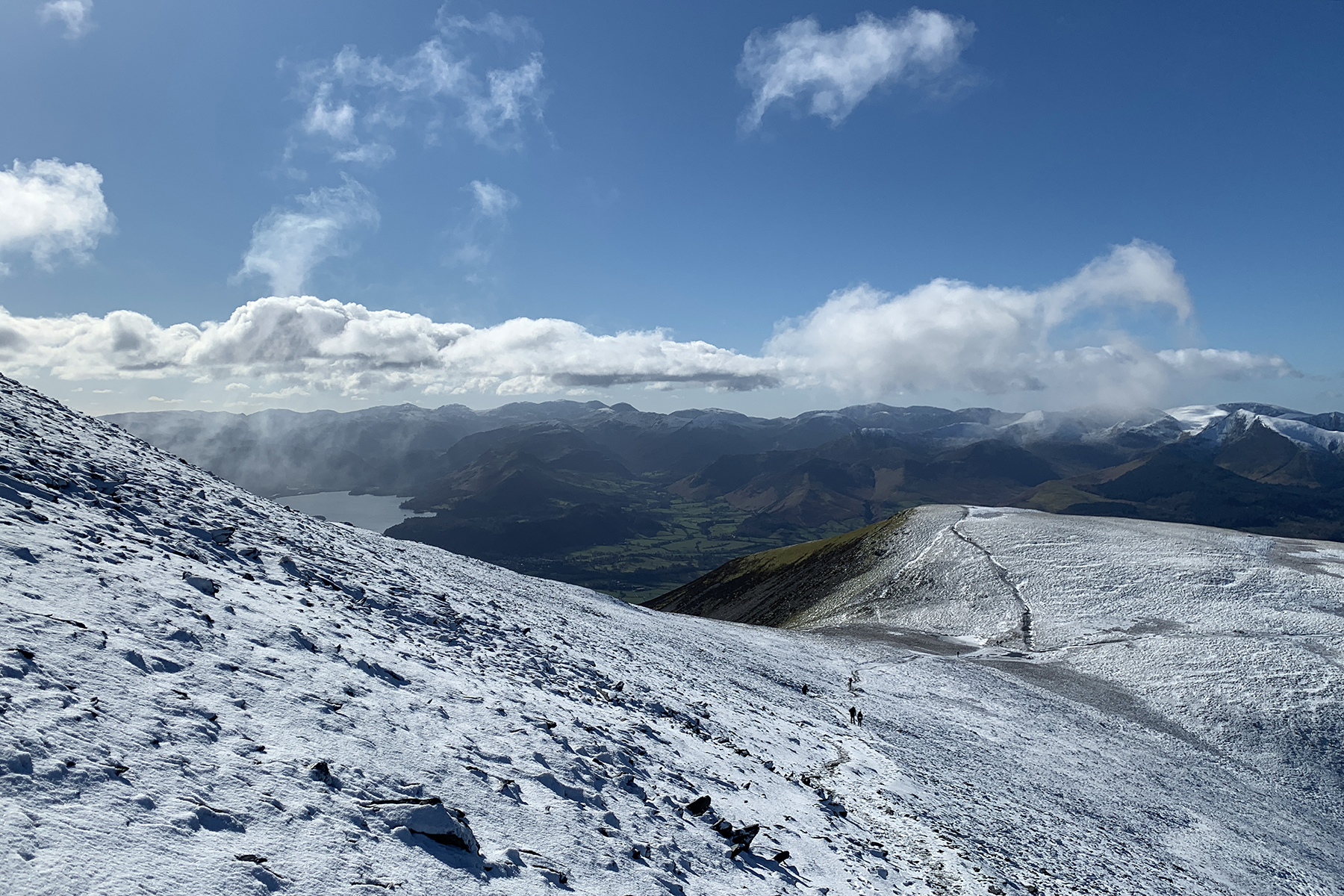
Apart from the wind perhaps! Chatting to other climbers at the top, we were having to shout above the howling tempest just to make ourselves heard. I took shelter behind a mound of rocks which served as an effective windbreak, for a short time, refuelling and adjusting my gear. Whether it was the altitude or the cold conditions I’m not sure, but my iPhone was behaving rather erratically now. Its camera stopped working and I had to reboot it altogether once or twice just to jump start it and get it going again. Thankfully I also had my DSLR with me to record the moment in the event that the iPhone simply gave up the ghost.
My route back down to Keswick was a bit more improvised. Leaving the summit behind and retracing my steps for a hundred yards or so, I then veered off the main track to follow a less-trodden route to the right – an obscure path in fine weather by all accounts, but this time almost imperceptible beneath the snow. The track was a steep descent of Skiddaw’s south-western slope, made quite difficult by the snow which lay knee-deep in parts. I rued my half-witted decision not to bring my trekking poles on this occasion, as I yielded to let other hikers with theirs pass me by more nimbly – the rogues! This route would however allow me to bag one additional Wainwright, so on I trudged, carefully, deliberately, and yes… heroically, towards the gentler saddle between Skiddaw and Carl Side. The view at this point (as if it could ever be in doubt) was breathtaking, once again. The mist rising up at speed from the valley and climbing over Carl Side, with the rocky ridge of Long Side to Ullock Pike as the backdrop, was a momentous sight. As I looked back to where I’d come from, the clear, uninterrupted view I’d had from the highest point of my climb was already completely hidden by dense mist and cloud. Mere minutes, it seems, are enough for the Lake District’s dynamic conditions to change the landscape.
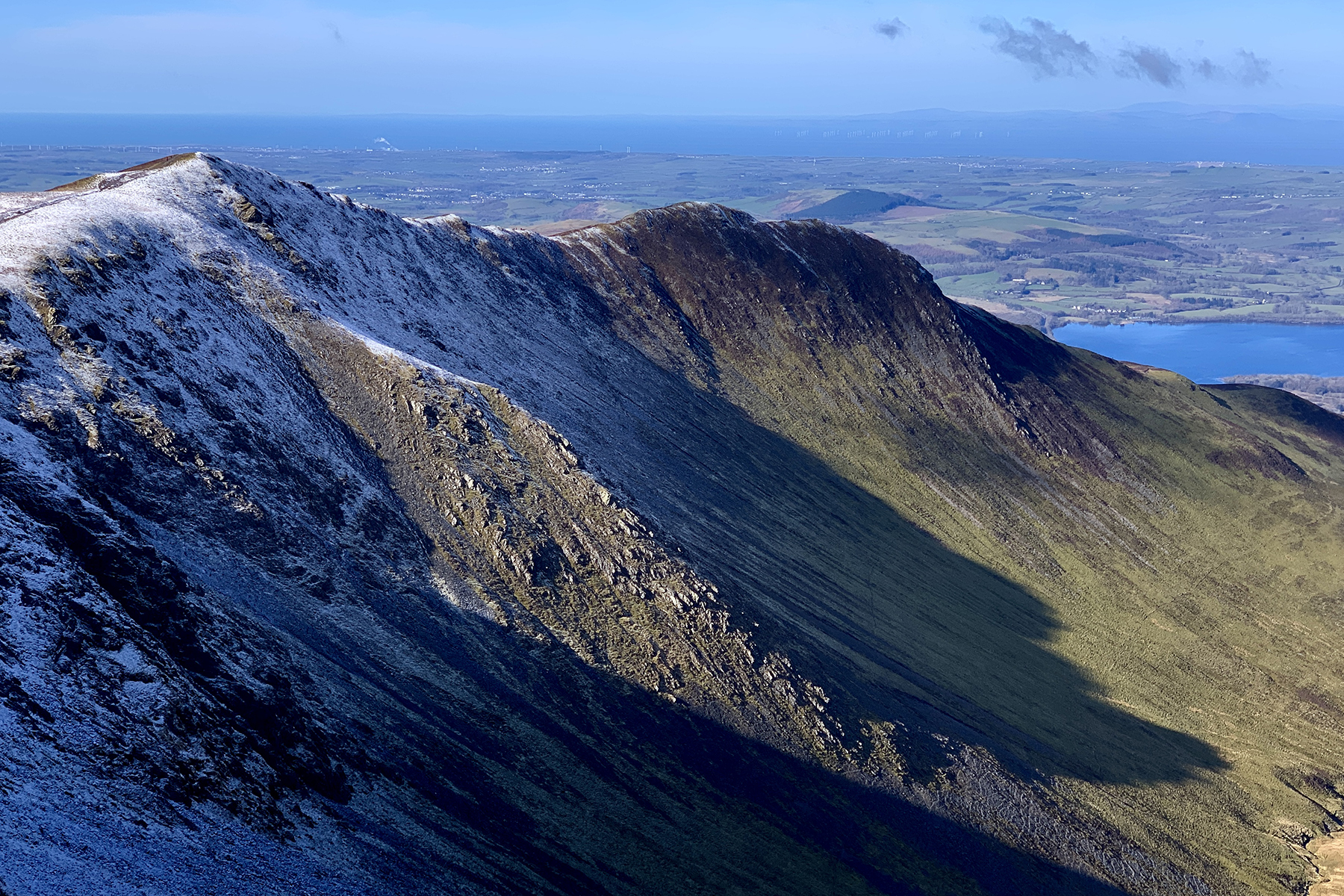
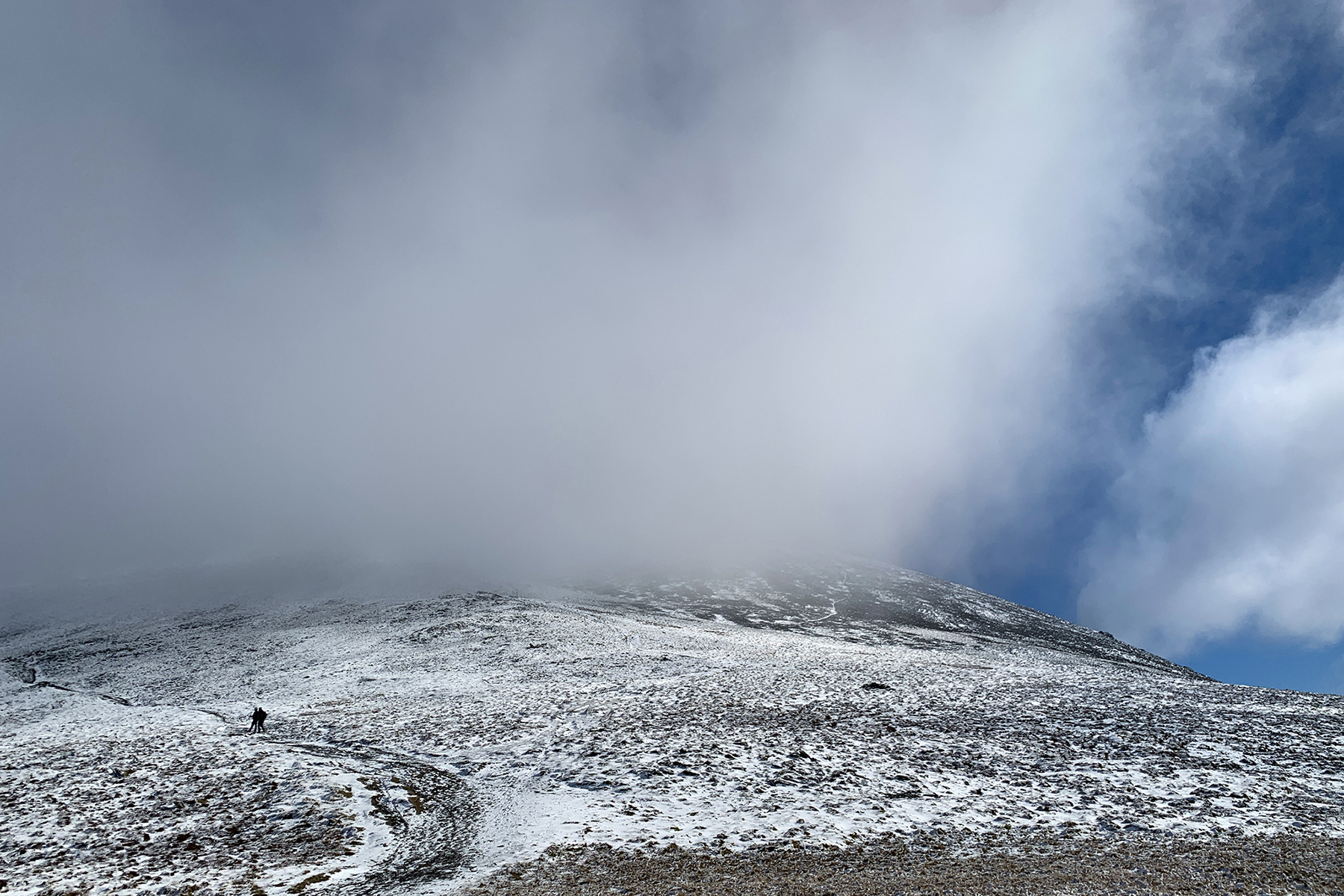
Carl Side conquered (a mere triffle by comparison), I made my way homeward, leaving the snow behind. I stopped briefly at a rocky outcrop where it was now (amazingly) warm and dry, for another quick dip into my victuals before continuing. To mitigate the gradient at the final descent, the path was compressed into a series of short zigzags, before disappearing altogether into open grassy slopes, where a gnarly, weather-worn fell-runner came tearing past me at a sprint, making me feel completely innadequate as my knees creaked (almost audibly, I thought) with every step. A final push of 3km-or-so through the pretty villages of Millbeck and Applethwaite, delivered me back to Keswick, hungry, spent, but nevertheless perfectly exhilarated. What a hike!