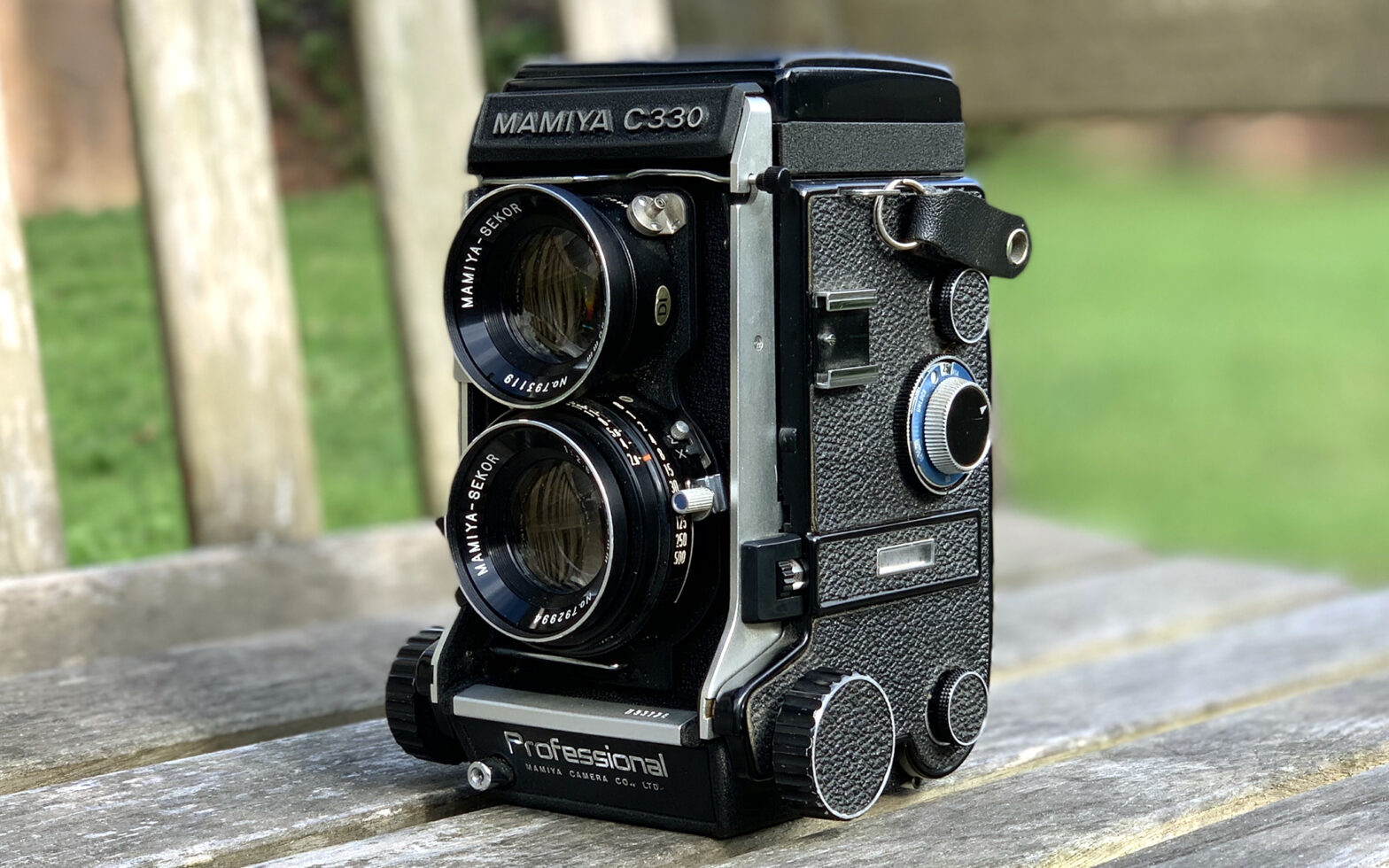
Project 2 (see my previous post) draws ever closer to inception, with the exceptionally exciting news that I’ve bought myself a new camera. Yep… new camera, baby! Woop woop! Well, truth be told it’s a new, old camera; vintage, you might say. It dates from about the year I was born actually, so… on second thoughts I’m not going to refer to it as vintage again – I’d rather not couple myself with that particular adjective. So I think I’ll just call it “awesome”.
But let’s not get too side-tracked by my musings on mortality; why don’t we get technical for a moment instead? It’s a Mamiya C330 Professional, twin-lens reflex camera, with an 80mm f/3.7 lens, made by the Mamiya Camera Company Ltd. in Japan, in various iterations between 1969 and 1994. This particular model was manufactured in the early 70s, and she’s an absolute beauty. Just look at her!
A twin-lens reflex (TLR) camera has two lenses of the same focal length; the lens at the top is the “viewing” lens and the one below is the “taking” lens. It has a waist-level viewfinder, so you hold the camera at waist height and look down onto a viewing screen on the top of the camera (a hood flips up, to shield the screen from ambient light, to make it a bit clearer). Probably the most famous TLRs are the Rolleiflex cameras made by Franke & Heidecke in Germany. However, where the Rolleiflex had a fixed lens, the Mamiyas had a series of seven interchangeable lenses of various focal lengths – almost unique for a TLR. Focusing is achieved by use of a bellows system, meaning you can get pretty close to a true macro shot without having to buy a dedicated lens; a great bonus feature.
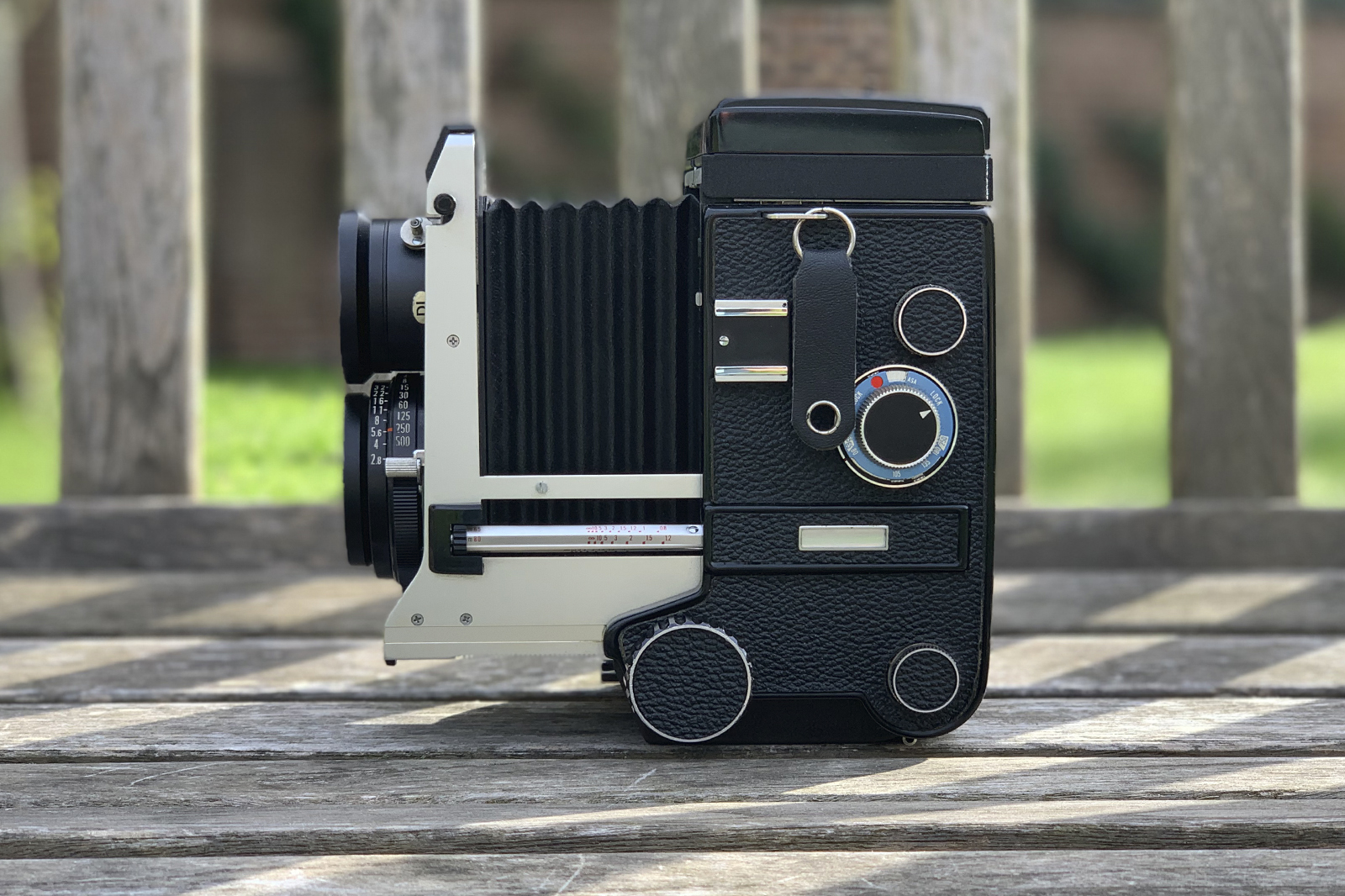
There are a few frustrations however, although they are only temporary. First and foremost, when I received the camera, I gave it a thorough once-over to make sure everything was as it should be. There’s no doubt that for its age it’s in spectacularly good condition. I almost can’t fault it… almost. Annoyingly though, the light seals need replacing. These are thin strips of black, compressible foam around the inside edges of the film door, to prevent light from getting in. They’re completely perished on my camera, and just flake and crumble to the touch. Thankfully, replacing them is a job I can undertake myself, and I’ve already bought some new light seal foam, but I just know that it’s going to be a really intricate job and I’m really not looking forward to it. I might write another post about this.
A couple of other frustrations (although nothing to do with the camera itself)… I won’t be able to post any photos taken with this camera for a little while yet. Apart from the aforementioned light seal issue, I also need to get some film, shoot it, get it developed and then figure out how I’m going to digitise the results. The most common approaches are to scan the negatives using a flatbed scanner (more cost), photograph the negs with a digital camera (achievable, but seems to defeat the object of shooting film, somewhat) or send the negs off to be drum scanned (by far the best option in terms of quality, but at something like at least £15 per frame, this could become prohibitively expensive very quickly).
I’m veering towards the flatbed scanner route, but I probably need to save a few more pennies first. It’s not cheap this film photography lark!
All that aside, I’m so, so excited to try this baby out. There’ll be some experimentation with different films and making sure I’m comfortable with manual metering and all that, but I’m thrilled with the camera, and particularly happy that I’ve been able to get one in such great shape. Love it!